
Hope yours are merry and bright.
Category: Uncategorized
-
Happy Holidays
-

After the Last Santa Train: What Happens Next?
The platform lights are dark. The last families have driven home with sleepy kids clutching candy canes. Somewhere in a cold shop building, a locomotive is cooling down for the first time in weeks.
It’s the moment every heritage railroad works toward all year. And the moment that can break an organization if they’re not careful.
The Quiet That Nobody Talks About
Holiday trains are the lifeblood of most tourist railroads. For many operations, those six weeks between Thanksgiving and Christmas represent 40 to 60 percent of annual revenue. The North Pole Limited. The Polar Express. Santa’s Lighted Forest. Whatever you call yours, it kept the lights on.
But here’s what the brochures don’t mention: the week after Christmas is when the real work begins.
Equipment that’s been running hard needs attention. Volunteers who pushed through double shifts need rest. And leadership needs to take an honest look at what worked, what didn’t, and what nearly went sideways.
Most organizations skip this step. They’re exhausted. They want to coast into January. That’s a mistake.
The 72-Hour Window
The best-run heritage railroads I’ve seen treat the first 72 hours after their last holiday departure like a structured debrief. Not a party. Not a collapse. A debrief.
Walk the equipment. Document everything while memories are fresh. That weird noise the coach made on December 20th? Write it down now or lose it forever. The volunteer who mentioned a near-miss with a passenger? Get that conversation on record before the holidays scatter everyone.
This isn’t about blame. It’s about building institutional memory. Heritage railroads lose knowledge constantly. Volunteers move. Key people pass away. The only defense is documentation, and the best time to document is while the season’s lessons are still raw.
The January Cliff
Here’s an uncomfortable truth: many heritage railroads lose 20 to 30 percent of their active volunteers between December and February.
Some of it is natural. Snowbirds head south. Schedules shift. But a big chunk of that loss is preventable burnout. Volunteers who gave everything during the holiday rush and got nothing back but another ask.
If your organization doesn’t have a plan for volunteer appreciation and rest in January, you’re spending down your most valuable asset.
This doesn’t require a big budget. A handwritten note from leadership. A small gathering in February when things calm down. Recognition in your newsletter that names specific people and specific contributions. The details matter less than the intention: showing your people that you noticed.
Money In, Money Out
Holiday revenue feels like a windfall. After months of scraping by, suddenly there’s cash in the account. The temptation is to immediately start spending on that project you’ve been putting off.
Slow down.
The organizations that thrive long-term treat January as a financial reckoning. How did actual revenue compare to projections? Where did costs creep higher than expected? What’s the real margin after you account for the overtime, the emergency repairs, the weather cancellations?
Get your board to look at these numbers in January, not March. The patterns are easier to see when the season is still fresh. And if something went wrong financially, you want to catch it before it becomes a habit.
Planning for Next Year Starts Now
I know. You just finished this year. The last thing you want to think about is next December.
But the decisions that shape your next holiday season are made in the first quarter. Will you add capacity? Change your ticketing system? Adjust pricing? Recruit for specific volunteer gaps?
The railroads that run the smoothest holiday operations aren’t working harder in November. They’re working smarter in January.
The Real Gift
Here’s what I keep coming back to: the holiday train season isn’t just about revenue. It’s about the families who’ll remember that ride for decades. The kids who’ll grow up and bring their own children back someday.
That magic doesn’t happen by accident. It happens because people like you do the unglamorous work in the off-season. The maintenance. The planning. The relationship-building.
So take a breath. You earned it. But don’t take too long.
The next Santa train is only 340 days away. -
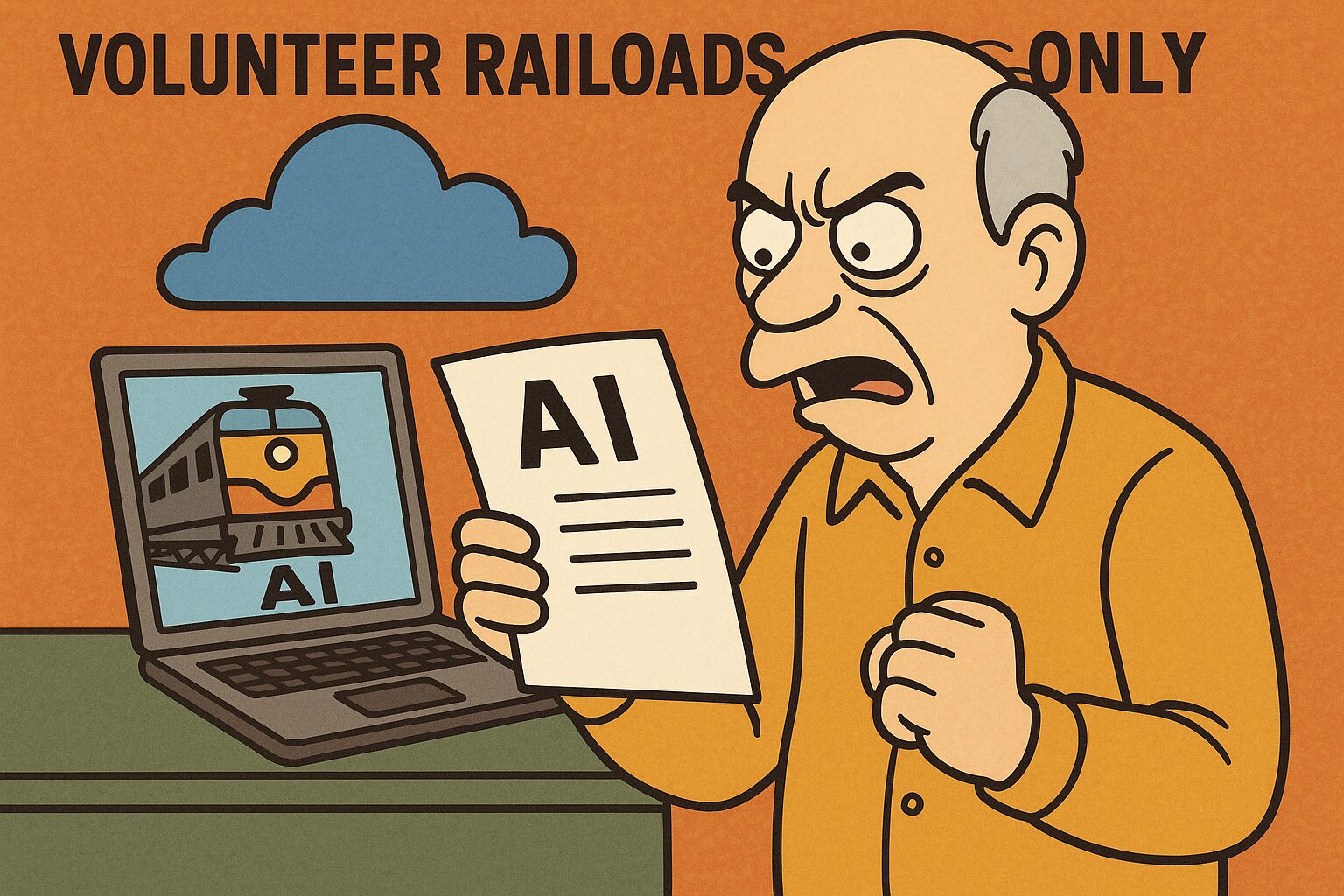
The AI Joke That Backfired: What Heritage Organizations Need to Know About Tech and Trust
I cracked a joke in an email to a longtime volunteer. It bombed. Badly.
The volunteer had asked for their hours tally with some peculiar grammar in their email. I pulled the data, sent it over, and added what I thought was a playful line: “I also had AI compose this email to you ;-).”
The reply came back polite but pointed: “I have no idea what you mean, perhaps my writing style is a joke to you.”
Oof.
I responded immediately with a genuine apology, explaining my intent wasn’t to diminish their value but to make light of the mundane data work. But the damage was done, and the lesson was clear: in preservation work, where volunteers are the lifeblood and respect is currency, even offhand tech references can land like insults.
This wasn’t just about my poor word choice. It revealed something bigger about how AI language intersects with heritage work, volunteer culture, and organizational trust. Here’s what I learned, what the research shows, and what we can all take away.
Why This Hit Different
Volunteers in preservation organizations aren’t just logging hours. They’re memory-keepers, storytellers, and the connective tissue between past and present. When you work with dusty rail cars, locomotives, and artifacts that require hands-on expertise, there’s an inherent tension when digital tools enter the picture.
My joke about AI “composing the email” of the volunteer’s hours accidentally suggested their contribution was reducible to a data point. What I meant as “hey, I ai too” read as “a robot could do what you do.”
In heritage work, that’s not just tone-deaf. It’s existential. These volunteers have specialized knowledge that no algorithm possesses. They can identify a brake valve by touch or explain why a particular restoration technique matters for historical accuracy.
When you joke that AI handled their requests, you’re unintentionally saying: “Your work is fungible. Your expertise is optional.”
No wonder it stung.
What the Research Reveals
This experience sent me down a research rabbit hole. Turns out, nonprofits and heritage organizations are wrestling with AI adoption in ways that amplify these tensions:
Resource and readiness gaps are real. Most nonprofits lack the infrastructure, funding, and strategic clarity to implement AI effectively. A 2024 study by the Center for Effective Philanthropy found only 11% of funders provide support for nonprofits to adopt AI tools. We’re expected to modernize without the means to do it thoughtfully.
Transparency matters enormously to stakeholders. A donor sentiment study surveying 1,006 people found that 86% said transparency around AI use is very or somewhat important. While 82% were familiar with AI and 48% saw fraud detection as a benefit, the message was clear: tell us what you’re doing with these tools.
Adoption is happening fast, but governance lags behind. A UK study of grassroots nonprofits found 78% were already using generative AI tools by mid-2024. However, they flagged major concerns about readiness, oversight, and ethics. We’re implementing before we’re prepared.
Heritage work faces unique ethical challenges. In the cultural sector, AI is being used to digitize manuscripts, reconstruct artifacts, translate endangered languages, and create digital twins of monuments. But these applications raise critical questions: Who owns the digital twin? Who decides what gets preserved or prioritized? Whose voices are centered or erased?
The bottom line: AI has genuine promise for efficiency and capability. But in mission-driven, community-centered work like ours, the “how” and the “who” matter as much as the “what.”
Five Takeaways for Heritage and Preservation Work
Let me get practical. Here’s what my email mishap and the broader research landscape taught me about using AI responsibly in heritage organizations:
1. Position tech as supporting humans, not replacing them
Your volunteers aren’t interchangeable parts. They’re the reason your organization exists. When you mention AI or automation, frame it clearly: “This tool helps me with the administrative grunt work so I have more time to work alongside you, hear your stories, and support the hands-on preservation you do.”
Never let technology language accidentally erase the human contribution. Make the hierarchy explicit: people first, tools second.
2. Be radically transparent about what AI does
If you’re using AI for donor segmentation, volunteer scheduling, or data analysis, say so. Explain what the tool does, what it doesn’t do, and how you maintain oversight.
This isn’t just good practice. It’s what your stakeholders want. Research shows that transparency builds trust, while opacity breeds suspicion. When people understand your tools serve them rather than surveil them, they’re far more receptive.
3. Don’t confuse efficiency with relationship
Yes, 71% of nonprofits using generative AI cite efficiency as the primary benefit. But if you automate everything, you lose what makes preservation work meaningful: personal recognition, authentic relationships, hands-on collaboration, and the stories that can’t be captured in a database.
My joke misfired because it inadvertently suggested efficiency mattered more than the person. In heritage work, that’s exactly backward. The inefficient parts (the conversations, the shared work, the mutual respect) are often the most valuable.
4. Build governance before you build systems
Before implementing AI for volunteer tracking, donor outreach, or collection management, ask hard questions:
- Is our data quality good enough to avoid biased outputs?
- Have we considered how volunteers will perceive this?
- What are the ethical implications of using personal data this way?
- Who makes decisions about what gets automated and what stays human?
Heritage organizations steward more than objects. We steward stories, relationships, and community trust. Even small tech decisions have legacy consequences. A digital catalog that erases a marginalized community’s contribution isn’t just bad data. It’s bad history.
5. Craft your messaging with care
This is where I failed. A throwaway line about “AI composing” the email landed as dismissive because I didn’t consider my audience: long-tenured volunteers in a preservation field where hands-on expertise and legacy matter deeply.
When you discuss AI with your community, try language like: “I’m using a tool that handles the spreadsheet work so I can focus on what matters, supporting you and the preservation work we do together. The tool serves us, not the other way around.”
Align the technology with service and respect. Make clear that automation exists to honor human contribution, not minimize it.
The Bottom Line
I’m grateful for this stumble. That careless line about AI taught me how powerful (and sometimes invisible) our tech language can be, even in a small railroad historical society.
We’re people. We’re memory-keepers. We’re community. Yes, we can and should use cutting-edge tools (AI, donor databases, digitized archives) to make our work more effective. But only if those tools genuinely serve the people doing the heavy lifting.
If your nonprofit, heritage group, or preservation organization is exploring AI, go ahead. But do it with humility, transparency, and deep respect for the volunteers, staff, and community members who make your mission possible.
Because the day your AI joke lands better than your heartfelt “thank you for giving 350 hours this year,” you’ve got things backward. And trust me, I learned that lesson the hard way.
-
Small Things Matter
Small things have a way of snowballing. And the time we had to find a new embroidery vendor? Easily top five.
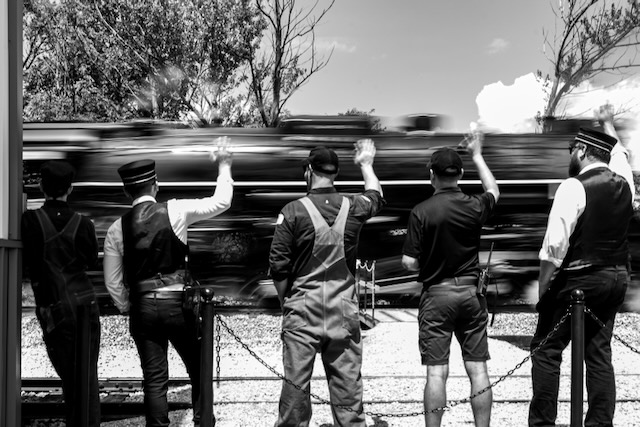
It started simple enough: black polos, crew shirts. Car host uniforms. Logo over the heart. All matching, all stitched with pride. Clean. Professional. Not covered in coal dust for at least ten minutes. Then our embroiderer dropped a red signal and died.
At first, I brushed it off. We’ve got bigger problems, right? Schedules to finalize. Safety meetings, budgets, broken coaches. Shirts could wait.
Except they didn’t.
Cue the emails.
“Who do I take this shirt to?”
“I called the number in the book and no one answered.”
What started as a minor errand turned into a low-grade emergency. Because while it felt small to me, it wasn’t small to the volunteers. For them, that shirt means something. It’s the badge. The uniform. The visible proof that they’re part of this crazy, wonderful machine we all work so hard to keep running.
And they’re right. That logo on the chest is as important to some as the coal is to the engine. It’s what keeps the fire lit. It’s pride made wearable.
Meanwhile, I’m still juggling Christmas train questions and reading a volunteer’s email that just says, “Received in the mail today,” with nothing else attached or written. Technically accurate, but about as descriptive as “train go.” I respect the mystery.
Eventually, the shirts will arrive. The logos will be stitched. And we’ll look sharp for maybe six minutes, until a kid with a candy cane weaponizes a hug.
If this has taught me anything, it’s that what seems small to me might be big to someone else. The little things are often the ones that matter most, and when we let them sit too long, they have a way of slipping through the cracks. Sometimes keeping the fire burning means remembering the small stuff before it’s forgotten, ignored, or left to die.